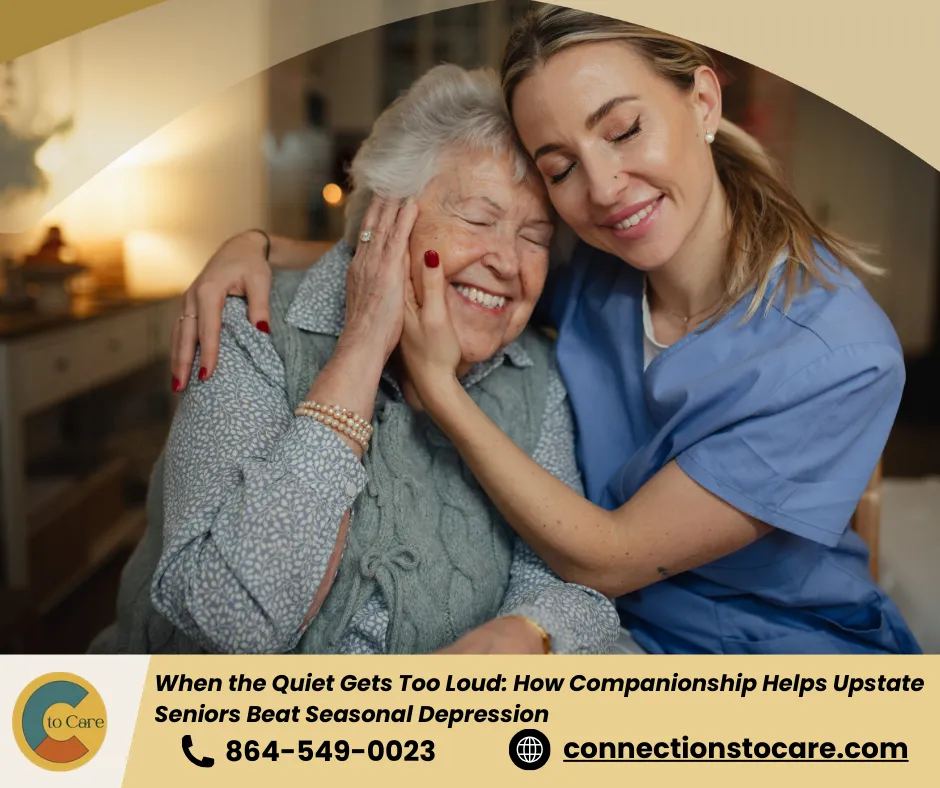
When the Quiet Gets Too Loud: How Companionship Helps Upstate Seniors Beat Seasonal Depression
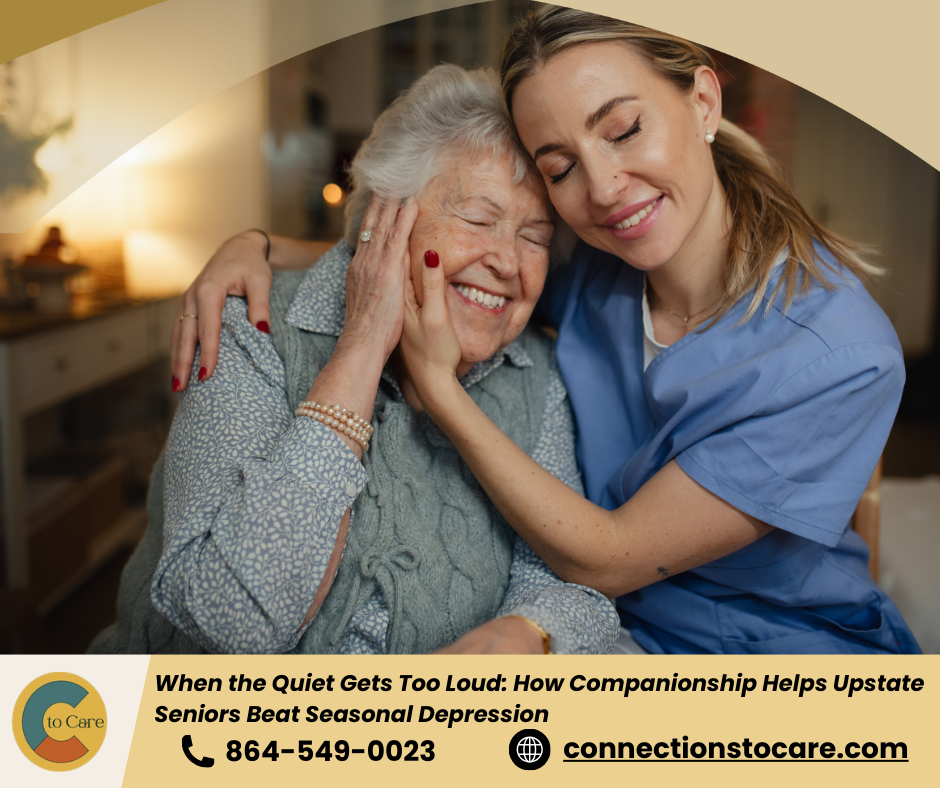
You might have noticed it gradually — the way your mom no longer rushes to turn on the morning news, or how your dad's answers on the phone have gotten shorter. Maybe your neighbor, the one who used to wave from her porch every single afternoon, has stopped coming outside. It's easy to tell yourself it's just the season, just the weather, just getting older. But sometimes, that quiet has a name: loneliness — and it is doing real damage.
Here in the Upstate, we like to think of ourselves as a tight-knit community. From the Saturday bustle of the Swamp Rabbit Trail to the warmth of a Sunday afternoon in Travelers Rest, connection feels woven into the fabric of who we are. But for many of our older neighbors, that same community can feel impossibly far away — especially during the gray stretch between November and March, when the days grow short and the reasons to step outside seem to shrink right along with them.
At Connections to Care, we see this every season. And what we have learned — backed by research and lived experience — is that consistent, genuine human companionship may be one of the most powerful tools we have to help.
The Loneliness Epidemic Is Real, and It's Right Here
This isn't a big-city problem. Social isolation among older adults is one of the most significant and underreported health crises in America right now, and Greenville County is not immune. According to the National Institute on Aging, nearly one in four adults aged 65 and older is socially isolated — and the consequences go far beyond just feeling sad. Chronic loneliness is linked to increased risk of heart disease, accelerated cognitive decline, and clinical depression.
What makes it so easy to miss? Because the symptoms often look like "just aging."
Subtle withdrawal from favorite activities. Trouble sleeping. A loss of appetite. Low energy that doesn't seem to lift. A kind of flatness in the voice that wasn't there before. These are not just the normal wear of growing older. They may be signs of seasonal depression — and in some cases, a diagnosable condition called Seasonal Affective Disorder, or SAD.
What Is Seasonal Depression, and Why Does It Hit Seniors Harder?
SAD is a pattern of depression that follows the calendar. The most common form tracks with late fall and early winter — when shorter days mean less sunlight, less serotonin activity in the brain, disrupted sleep cycles, and lower vitamin D levels. A less common form can appear in early summer. When symptoms return at roughly the same time each year for two or more consecutive years, a qualified provider may diagnose SAD as a clinical condition.
For older adults, the risk is compounded. Retirement removes the built-in social structure of a workplace. Mobility challenges make it harder to get out and about. The loss of a spouse or longtime friends leaves a silence that is difficult to fill. Driving may no longer be safe. The combination of these factors means that what might be manageable for a younger person becomes genuinely dangerous for a senior.
And for the family members watching this unfold — the daughter driving over from Simpsonville twice a week, the son calling every night from Spartanburg — it creates its own weight. Caregiver burnout is real. Guilt is real. Feeling like you're never doing quite enough is real.
Why Companionship Is More Than "Just Visiting"
Here's something that often surprises families: you don't need a clinical intervention to make a clinically meaningful difference. Research consistently shows that regular, structured social connection — even simple conversation and shared activity — can measurably reduce the symptoms of isolation and seasonal mood decline.
That's what professional companionship care looks like in practice. It's not a medical service. It's a consistent, caring presence that shows up.
A trained companion caregiver from a reputable home care provider like Connections to Care can:
Establish a predictable daily and weekly routine, which stabilizes mood and creates something to look forward to
Encourage light physical activity, whether that's a walk around the neighborhood in Greenville's friendlier spring weather or gentle stretching indoors on a cold January morning
Provide safe transportation to appointments, social events, or even a favorite lunch spot on Augusta Street
Offer genuine conversation — not distracted, not rushed, not half-watching a phone
Gently monitor behavioral changes and communicate concerns to the family before they become crises
That last point matters more than people realize. A professional caregiver who knows your loved one well is often the first to notice when something has shifted — a new confusion, a worrying comment, a refusal to eat. That early awareness can be the difference between a manageable situation and an emergency.
Teepa Snow, one of the leading voices in non-medical senior care, has long emphasized that consistent, present human engagement is not supplemental to a senior's wellbeing — it is the wellbeing. You cannot medicate your way to connection. You have to show up for it.
What Good Care Looks Like in the Upstate
If you're beginning to explore options for a parent or loved one, you don't have to figure it out alone. The Upstate has resources, and knowing where to look matters.
The Greenville County Council on Aging offers programs ranging from Meals on Wheels to community center activities that can complement in-home care. The Prisma Health Senior Services network can connect families to geriatric assessments and mental health resources when clinical evaluation is needed. And organizations like the Family Caregiver Alliance provide support specifically for the people doing the caregiving — because you matter in this equation too.
When evaluating home care providers, look for agencies that are members of the Home Care Association of America (HCAOA) — this indicates they meet employment-based standards for caregiver hiring, training, and supervision, rather than relying on loosely regulated gig-economy contractors. That distinction is not a small one when it comes to consistency of care and your loved one's safety.
At Connections to Care, we serve families throughout Greenville and the surrounding Upstate with non-medical companion care designed to do exactly what the name suggests: create real, meaningful connection. Whether your loved one needs a few hours of company a week or more comprehensive daily support, our goal is always the same — to make sure they never feel like they're weathering this season alone.
The First Step Is the Conversation
If you've read this far, you're probably already sensing that something needs to change. Trust that instinct. Atul Gawande, the physician and author of Being Mortal, has written powerfully about how our instinct as caregivers is often to manage and fix — when what our loved ones actually need most is to feel seen, heard, and connected to a life that still has meaning and texture.
Companionship won't replace medical treatment when it's needed. But it is, in the most human sense of the word, irreplaceable.
If you're in the Greenville area and want to talk through what support might look like for your family, we're here. No pressure, no sales pitch — just a real conversation about what your loved one needs and how we might be able to help.
📞 (864) 549-0023 🌐 www.ConnectionsToCare.com ✉️ [email protected]
Because nobody should have to sit alone and wait for the season to change.
