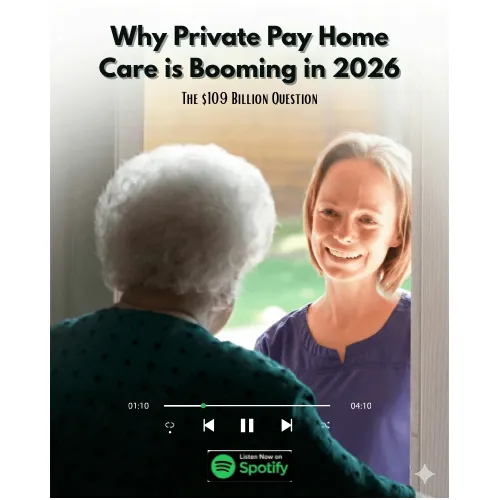
"The $109 Billion Question: Why Private Pay Home Care is Booming in 2026"

"The $109 Billion Question: Why Private Pay Home Care is Booming in 2026"
The $109 Billion Question: Why Your Parents (and Mine) Are Choosing to Stay Home
Something remarkable is happening across Upstate SC—and across America.
While we've been focused on our daily routines here in Greenville, a quiet revolution has been taking place in our parents' living rooms, back porches, and kitchen tables. They're making a choice that's reshaping the entire landscape of aging in America: they're staying home.
The numbers tell a story that probably mirrors what you're seeing in your own family. The private pay home care market is exploding—growing from $75.6 billion in 2021 to a projected $109.9 billion by 2026. That's not just a statistic. That's millions of families, right here in the Upstate and across the country, fundamentally rethinking what it means to age well.
The 77% Who Said "No Thanks" to the Nursing Home
Here's the truth: 77% of adults over 50 prefer to age in their own homes. Not in a facility. Not in an institutional setting. Home.
And honestly? When you think about it, that makes perfect sense.
I spoke with a local Greenville resident, Margaret, whose 84-year-old mother still tends her azalea garden on Pelham Road. "She knows every neighbor by name," Margaret told me. "Moving her to a facility would mean uprooting her from 40 years of community. Why would we do that if there's another way?"
That "other way" is what geriatrician Louise Aronson calls honoring elderhood as a distinct, valuable life stage—not a medical problem to be managed in an institutional setting. Your parents aren't broken; they're experiencing a rich chapter of life that deserves to unfold in familiar, meaningful surroundings.
Private Pay vs. Medicaid: Understanding the Difference (And Why It Matters)
Let's clear up some confusion, because this trips up a lot of families.
Medicaid-dependent care typically means you're working within tight restrictions—limited hours, specific qualifying conditions, and often long waiting lists. It's designed as a safety net, and it serves an important purpose.
Private pay home care is different. It's flexible, personalized, and built around what YOUR family needs, not what a government program allows. Need someone there at 6 AM to help Dad with his morning routine? Done. Want the same caregiver three days a week so Mom builds a real relationship? Absolutely. Need to adjust hours during a recovery period? No problem.
Think of it this way: Medicaid care is like taking the bus—it gets you where you need to go, but on a fixed route and schedule. Private pay is like having a driver who knows your preferred route, your favorite coffee stop, and doesn't mind if you need to make an unexpected detour.
Why Upstate SC Families Are Leading This Shift
There's something about the Upstate that makes this trend particularly strong here. Maybe it's our deep connection to community. Maybe it's the fact that many of our seniors have lived in the same neighborhoods for decades—they have relationships at Greenville Drive games, at their church on Augusta Street, at the Saturday markets downtown.
Dr. Atul Gawande, author of Being Mortal, argues that autonomy and purpose matter more than safety at all costs. And when you look at our Upstate seniors, you see that principle in action every day.
Your dad still wants to drive to his coffee group at Wade Hampton on Tuesday mornings. Your mom still volunteers at the Swamp Rabbit Trail cleanup. These aren't just activities—they're what give life meaning. Home care preserves these connections in ways institutional care simply can't.
What's Driving the Boom?
Several factors are converging right now:
The Sandwich Generation is saying "there has to be a better way." You're raising kids, managing careers, and now you're trying to figure out how to care for aging parents. The old model of "move them to a facility" doesn't fit modern family dynamics—or modern values.
Technology has made home care safer and more sophisticated. From medication management systems to emergency response technology to telehealth, seniors can access medical support without leaving home.
The COVID-19 pandemic changed everything. Families watched helplessly as loved ones in facilities were isolated from family during lockdowns. Many vowed: "Never again." The value of aging in place became crystal clear.
Better care options are emerging locally. Here in the Upstate, organizations like Connections to Care are bridging the gap between "doing it all yourself" and "institutional placement"—offering professional, compassionate support that keeps seniors connected to home and community.
The Real Question Isn't "Can We Afford It?"—It's "Can We Afford Not To?"
I know what you're thinking: "Private pay sounds expensive."
But here's what often gets overlooked: the cost of a nursing home in South Carolina averages $6,000-$8,000+ per month. Quality home care can actually be MORE affordable—especially when you're only paying for the hours you actually need.
More importantly, consider the cost of what you LOSE when someone leaves their home: their independence, their familiar surroundings, their sense of purpose, their community connections. How do you put a price tag on your mother's ability to wake up in her own bed, in the house where she raised her children?
What This Means for Your Family
If you're reading this, chances are you're already sensing that something needs to change. Maybe you've noticed Mom struggling with tasks that used to be simple. Maybe Dad's house isn't as tidy as it once was. Maybe you're spending your weekends shuttling between your own life and theirs, trying to keep all the plates spinning.
The $109 billion boom in home care isn't just about money—it's about a fundamental shift in how we value our elders and honor their wishes. It's about giving them the support they need while preserving the dignity, autonomy, and joy that make life worth living.
Your parents spent decades taking care of you. They deserve care that honors who they are and what they've built—not just medical management, but a rich, connected life in the place they call home.
Ready to explore what's possible?
Whether you're just starting to think about options or you're in immediate need of support, the conversation starts with understanding what home care can actually look like for YOUR family.
📞 Connections to Care | (864) 549-0023 💻 www.ConnectionsToCare.com 📍 Serving the Upstate, SC community
Because the best care honors both the past they've built and the life they're still living
